

Ramen School RAJUKU has become a destination for aspiring ramen chefs from around the world. Its owner and master chef, Takeshi Koitani, is a prominent figure in Tokyo’s ramen scene, having built and managed a string of celebrated shops. Coincidentally, our visit on April 22nd marked the 23rd anniversary of his very first restaurant, Jiraigen. This article traces his journey—a story not of chasing trends, but of unwaveringly pursuing the flavors he wants to create.
Before opening a ramen shop, Koitani worked many jobs, from working at a flower shop to hauling luxury furniture as a truck driver. It was during those long hours on the road that his serious ramen explorations began. “Whenever a delivery location was decided, the first thing I did was open a ramen guidebook and search for promising shops nearby. Back then, most ramen joints felt like an extension of old-school Chinese diners.”
The more bowls he ate, the stronger his desire grew to make his own. At home, he began experimenting, refining recipes through endless trial and error. After nearly five years of study and practice, he opened his first shop at the age of 31. With no apprenticeship and no master, his confidence came from the accumulated experience of walking, tasting, and tirelessly refining.
Two formative experiences defined Koitani’s ramen awakening: Taishoken in Eifukucho and Aoba in Nakano. “When I first visited Taishoken, guided by a senior colleague at the flower shop, I was floored. The giant bowls, the heat of the noodles and broth, the sharp hit of dried sardines and bonito—it was powerful. I never knew ramen could punch like that.” Aoba’s double-soup style, combining pork bone and seafood, was equally revelatory.
As he explored more and experimented at home, his palate evolved. “The biggest influence was Minoru Sano’s Shinasobaya. Nothing stood out individually, but the balance was uncanny. Up to that point, I’d been drawn to strong, bold flavors—sardines, bonito, tonkotsu (pork bone broth)—but Sano’s ramen was shocking in its subtle harmony.”
Through tasting and studying countless ramen, what Koitani ultimately arrived at was a style that doesn’t seek to stand out. It is not a bowl defined by flash or dramatic impact, but one that carefully draws out the natural character of its ingredients, serving each element in perfect balance. In this way, he reconstructed traditional chūka soba into a ramen that is both profoundly deep and quietly powerful.
“Of all the ramen I’ve experienced, the greatest influence came from Minoru Sano’s Shinasobaya. Nothing in the bowl stood out individually, yet the harmony of the ingredients created a strangely compelling sensation. Before that, I had been drawn to ramen defined by bold flavors—strong dried sardine or bonito notes, or the unmistakable aroma of tonkotsu. Sano’s ramen was a revelation. Inspired by that balance, I combined elements I loved with similar principles to craft my own original ramen.”
It’s Like That — Born in ’96, Built by Fire at 26
Koitani was 26 in 1996, a year that would go down in ramen history. It was the year that many now-famous shops opened their doors: Menya Musashi in Aoyama, Kamon and Aoba in Nakano, and Kujiraken in Yokohama. Collectively, this wave of new openings came to be known as the “Class of ’96.” Around the same time, the focus in Japanese ramen began shifting—from regional specialties like Hakata, Kitakata, and Sapporo styles toward bowls that showcased the individuality and vision of the chef himself.
Riding this cultural momentum, Koitani opened Jiraigen: Garyu Umami Soba in 2002. By the time a decade had passed, he had become widely recognized as one of the defining figures of the gotōnin ramen movement—ramen defined not by its location, but by the chef’s personal philosophy and creativity.
While the norm among ramen chefs at the time was to train under renowned masters and then open a shop under their tutelage, Koitani distinguished himself by breaking free from the industry’s established molds. Rather than following a prescribed path, he boldly expressed his own tastes and vision, creating a ramen that was unmistakably his own.
“I had no money, no mentor. We painted the walls ourselves, sketched our own murals. I deliberately avoided the look of a ramen shop and went for an American live house vibe. Menu names like Thick Tsukejiru Soba FRIDAY (a dipping-style ramen broth) or Miso Soba HOLIDAY—that kind of English naming was rare back then, and it caught attention. Now ten years might still mean you’re a ‘youngster,’ but back then a decade was a milestone, and suddenly I was treated like an old hand, with interview requests pouring in.”
Old School Flavor, New School Flow
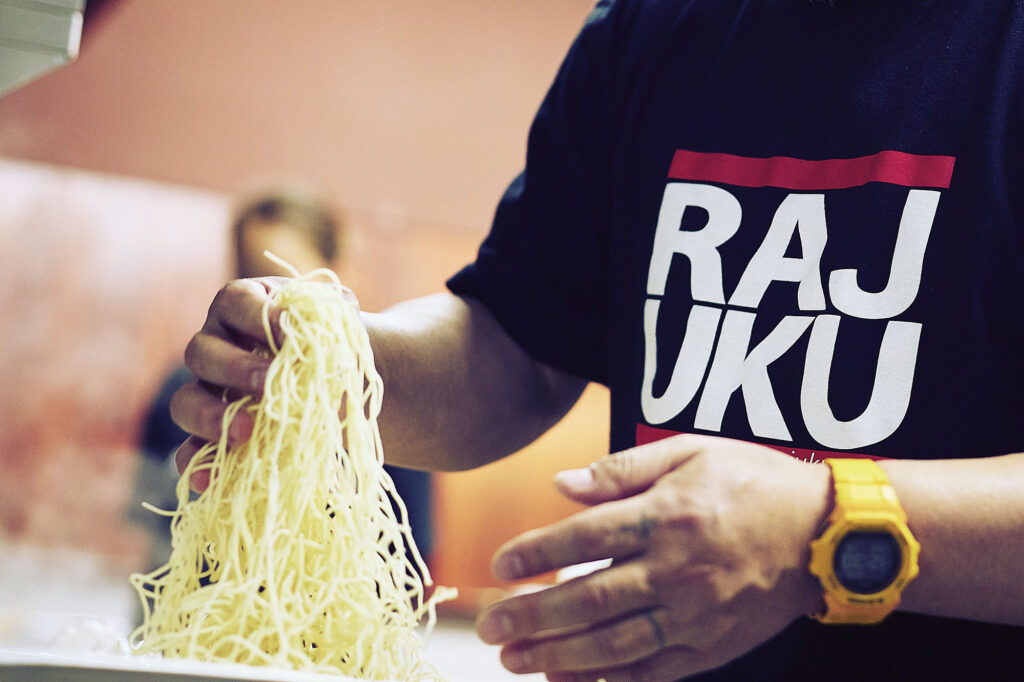
T-shirts shouting “RAJUKU IN THE HOUSE”, or the now-vanished shop in Fussa boldly named The Finest Noodles El Dorado, radiate Koitani’s unmistakable sensibility. Its roots trace back to childhood, when the film American Graffiti struck him with lasting force. From that spark came an obsession with 1950s rock, then a deep dive into rockabilly with friends, and eventually the pull of LA’s lowrider culture—Cadillacs bought and customized together. That journey naturally led him into the world of underground hip-hop. Koitani says “Back then, it wasn’t an age of overflowing information. To pursue what you loved, you had to dig: go to the scene, search things out, see and hear for yourself. That’s how friendships formed.”
“Before I opened my first ramen shop, I treated work as nothing more than a way to get by. But when it came to my passions, I poured myself into them completely. That obsession—with music, design, cars—became the very foundation of how I conceived and built my ramen shops. Without those personal pursuits, I probably would have done the ordinary thing: apprentice somewhere and open a shop under the master’s name, and never truly express my individuality.”
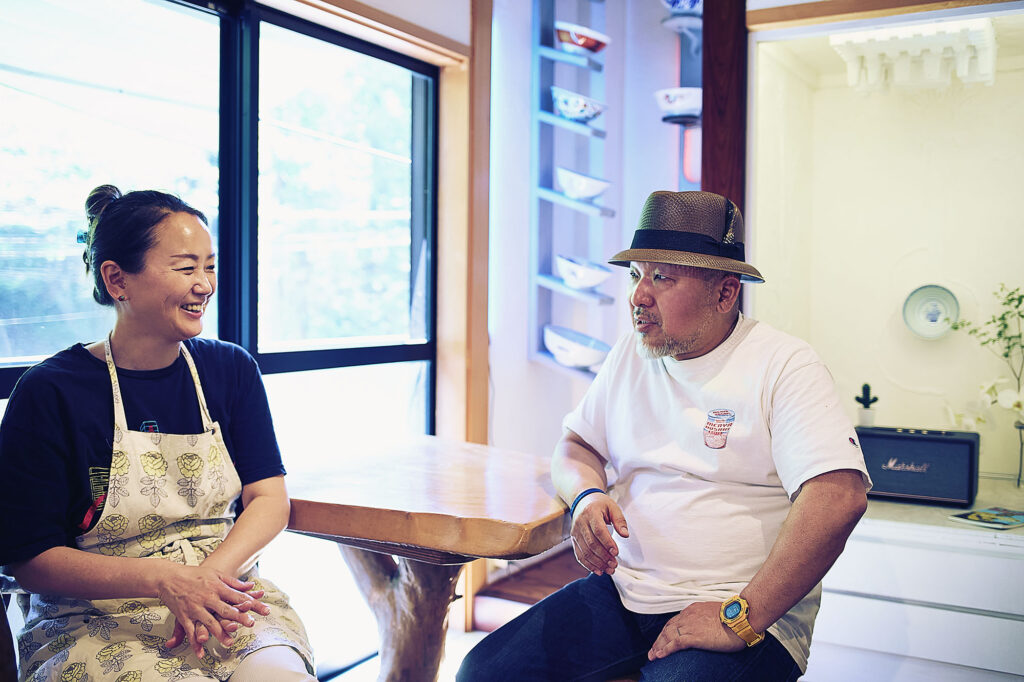
Through it all was his longtime partner Chihiro—now co-running RAJUKU—riding a Harley, sharing both work and life. When their children were small, she worked alongside Koitani behind the counter, with the kids strapped to her back.
On the day we visited, two students—one from China, one from the U.S.—were at work under their joint guidance. The quiet rhythm between them, wordless yet in sync, carried the weight of years spent building a life together.
Shokunin in the House
The global ramen boom has given rise to countless new styles—Instagram-ready noodles aligned in perfect rows, toppings presented on separate plates, ramen served as a multi-course experience. To Koitani, however, these innovations risk drifting away from ramen itself.
“For me, ramen is everything contained in that single bowl. Customers aren’t just tasting the noodles or the broth—they are absorbing the movements, the plating, the way it is served. Every gesture, every motion communicates flavor.”
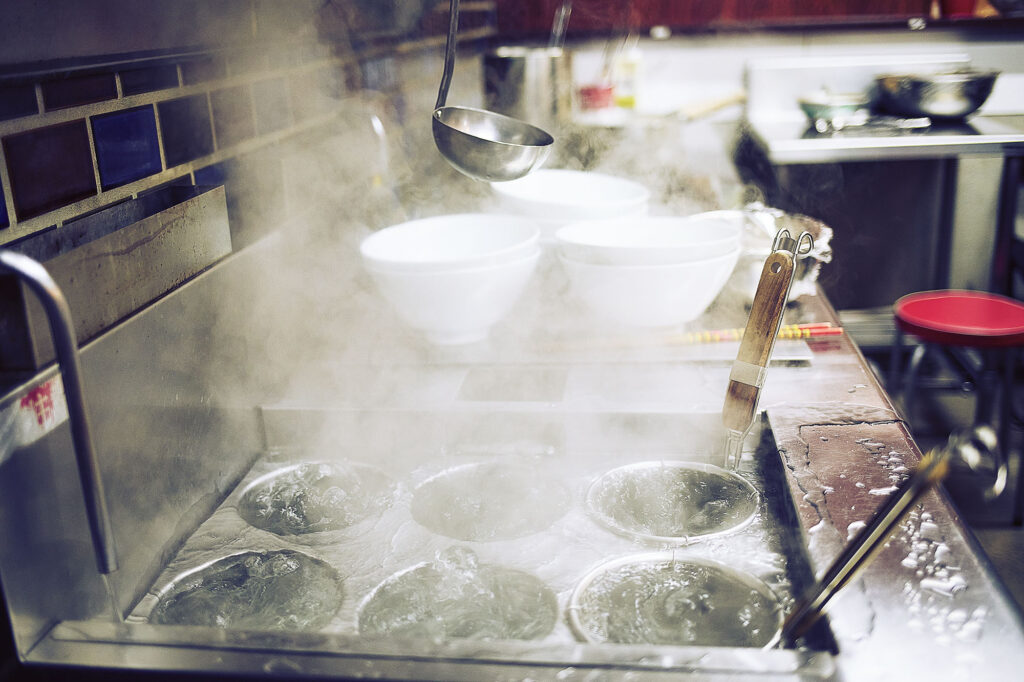
As variations proliferate, Koitani worries that the true essence of ramen may be diluted. Even with the same recipe and ingredients, the taste shifts with each cook, because every motion, every nuance carries meaning. This philosophy informs the teaching at RAJUKU, where the emphasis is on operations—the meticulous practice of preparing, plating, and presenting. Students are encouraged to innovate, yet they are held to professional standards: mistakes are met with a complete do-over, instilling discipline alongside creativity.
When asked what matters most for a ramen craftsman—the skills, the sensibility, the demeanor, or the determination—Koitani reflected on an Instagram post he once shared with his apprentices. “Above all, the most important thing is confidence. You can pour money into ingredients, spices, and decor, but if you lack confidence in your ramen, no customer will come. If a chef looks uneasy while preparing a bowl, diners immediately sense it and you can’t help but wonder, ‘Is this chef any good?’ Confidence shows in every gesture, in the movements of your hands, and in the presence you carry. And that is why truly great chefs are always surrounded by an aura of assuredness.”
“In the beginning, in any field—not just ramen—we tend to overdo it, cramming in too much. That’s passion without experience. But as skill and experience grow, you learn to strip things down. That’s when true craftsmanship emerges.”
And when it comes to gestures, even the eater has a role to play. “Soup is best enjoyed straight from the bowl, not with a spoon. Many foreigners aren’t accustomed to slurping noodles, so it can be hard for them to do it correctly. It’s like eating sushi with your hands—the movements themselves, the cultural ritual, are part of the flavor experience.”
In late May, Koitani unveiled Mojo Hand in Hinode—a fresh canvas for his creativity, even as he continues to guide students at RAJUKU and oversee projects abroad. Calling himself a “ramen shokunin”—a master craftsman—is no mere title; it is a statement of his commitment to remain a maker at the stove. He says, “These days some shop owners never stand behind the counter. But when I was discovering ramen, the masters of the great shops were always there, crafting each bowl with their own hands. That image has stayed with me. A true ramen shokunin belongs in the kitchen.”
Takeshi Koitani, Chef-Owner at Ramen school RAJUKU, Master Chef aka Jiraigen BOSS
With over 23 years of experience in the ramen world, Koitani has mastered everything from traditional techniques to modern trends. About 20 years ago, he opened his own shop—quickly becoming a local favorite with lines out the door. He was among the first to introduce a “double cropping” business model, offering two ramen concepts in one day, and went on to create multiple ramen brands. Today, he runs a ramen school focused on sharing the deeper values of Japanese food culture. For the past ten years, he’s been teaching aspiring chefs and producing ramen shops both in Japan and overseas. In May 2025, he opened a new ramen shop, MojoHand.
About Akiruno
Akiruno is located in the western part of Tokyo. The eastern part of Akiruno is a plain surrounded by gentle hills, while the western part features mountainous areas that are part of Okutama. The area once thrived on forestry and silk spinning, and the remnants of those days are shown in the old kominka that are still in existence, a testament to the history and culture of those times. The rich natural environment, exemplified by the Akikawa Valley, attracts enthusiasts of fishing, camping, hiking, and trail running. It is known as a place where the convenience of urban life can be combined with the pleasures of rural living.
こちらの記事は英語で執筆されており、ブラウザの自動翻訳により名前の漢字表記が正しく表示されないこと、不自然な日本語が表示されることがあるようです。お手数ですが、英語原文での閲覧をお試しください。