
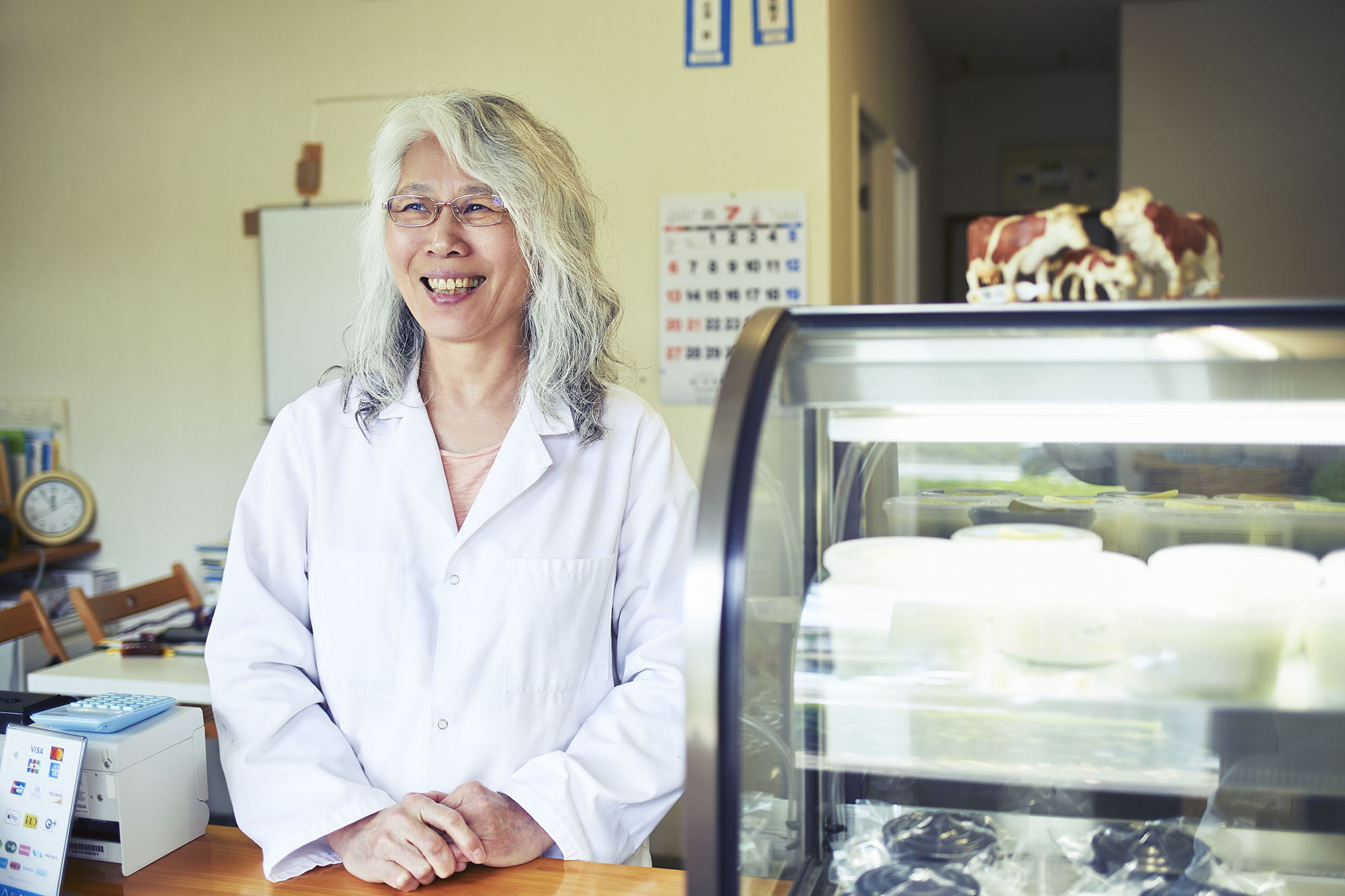
Nestled in the quiet region of Ome, Fromages du Terroir opens its doors only three days a week. True to its name, the shop is devoted to crafting cheeses that are composed on the character of the topography, pursuing flavors deeply intertwined with the region’s nature and culture. The only ingredients used are raw milk from Ome and the neighboring town of Mizuho—known collectively as “Tokyo Milk,” produced on the gentle, rolling pastures of the Tama area. High in butterfat, the milk lends each cheese a distinctive roundness and depth and a richness that speaks unmistakably of its place of origin.
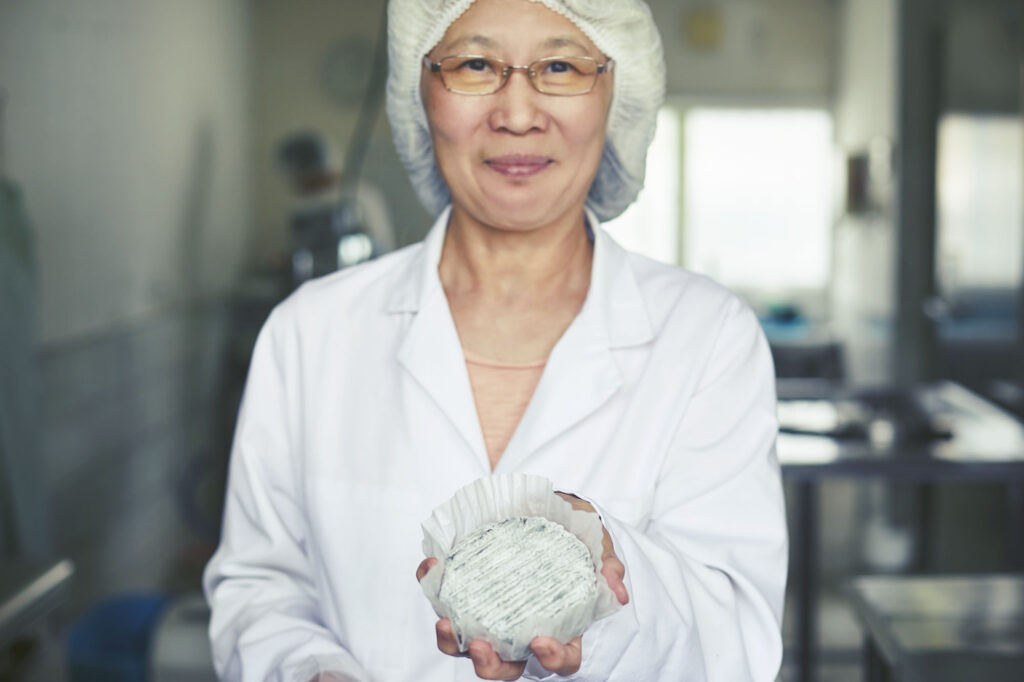
At the center of it all is Kazuko Tsurumi, one of Japan’s pioneering female cheesemakers. After three formative years studying at ENIL, France’s national dairy school, and earning qualifications to lead a cheese factory, she returned to Japan with a resolve to create cheeses that could exist only in this land. In 2014, she established her workshop in Ome, developing more than twenty varieties that blend classical French methods with the living character of Tokyo’s air, water, and naturally occurring microorganisms. Among her cheeses are select varieties washed with shochu or kimoto-style sake, and made with sake lees from the local Ozawa Sake Brewery’s Sawanoi label—expressions of her vision of “Tokyo terroir.”
Discovering Tokyo Terroir: Japanese Cheese Rooted in Place, Fermentation, and Tradition
——What does “terroir” mean to you?
Kazuko Tsurumi (KT): The term terroir is used quite casually in France. It describes the individuality of flavor shaped by everything that surrounds a place—its people, soil, climate, and the living environment that sustains it. Because I trained in traditional French cheesemaking, I wanted to create cheeses in Japan that carried a sense of their own land, and that is why I chose this name. When I opened the shop eleven years ago, the word had only just begun to appear in the world of wine here, and was still hardly known.
Today, the word terroir has become more common in Japan, but the interpretation often differs from that in France. Here, people tend to think that simply using local ingredients is enough to claim terroir. But in its true sense, that alone is not sufficient. For cheese, the native lactic bacteria and microorganisms of the region must be part of the process. Even if the milk comes from the region, if lactic cultures are purchased and added from outside, the cheese cannot fully express its place of origin. Yet in Japan, it is still common to see products described as “terroir” simply because they use local vegetables or soy sauce.
——So cultivating your own microorganisms is essential to terroir.
KT: In France, that distinction is very clearly understood. Large-scale factories use laboratory-cultured lactic bacteria to standardize their products, but small artisanal producers cultivate their own strains and sell directly within their communities. Because this approach is seen as the embodiment of true terroir, our workshop never purchases commercial starters. Instead, we make cheese using the microorganisms that occur naturally here—lactic bacteria, wild yeasts, even the blue molds in the air. Working this way allows the flavors and character unique to this land to emerge. By contrast, once you add industrially controlled cultures, the cheese begins to taste the same no matter where it’s made, and the true sense of place disappears.
——What characterizes Tokyo’s milk?
KT: Tokyo’s milk is light on the palate, yet depending on how it’s handled, its bitterness or acidity can surface easily. In France, bitterness is regarded as a defect, but for the Japanese palate it can actually serve as a layer that supports umami. By using Tokyo’s milk and water, we can bring out flavors unique to this land, even though ultra-high-temperature pasteurization—which is more common here—narrows the aromatic and flavor range compared with low-temperature milk.
——What is your philosophy in cheesemaking?
KT: What matters most to me is that food can be eaten with complete trust—and that its ingredients are allowed to show their natural strength. When I was a child in the 1970s, the flavor of milk grew progressively thinner until one day I simply couldn’t drink it anymore. After that, I became acutely aware of taste: the smell of meat, the subtle differences in fish, every nuance. Those experiences made me uncompromising about the quality of ingredients and how they’re handled. I avoid adding anything unnecessary; I want to bring out the milk’s natural goodness as simply as possible. Using local milk, water, and air, I create flavors that can only exist here.
For example, even when making mozzarella, milk from Tokyo can bring a slight bitterness. But that bitterness pairs beautifully with the umami of dashi or soy sauce. It offers not just “deliciousness” but a layered complexity that unfolds in the mouth. It becomes a cheese with a character entirely different from its Italian counterpart—something distinctly, unmistakably Japanese.
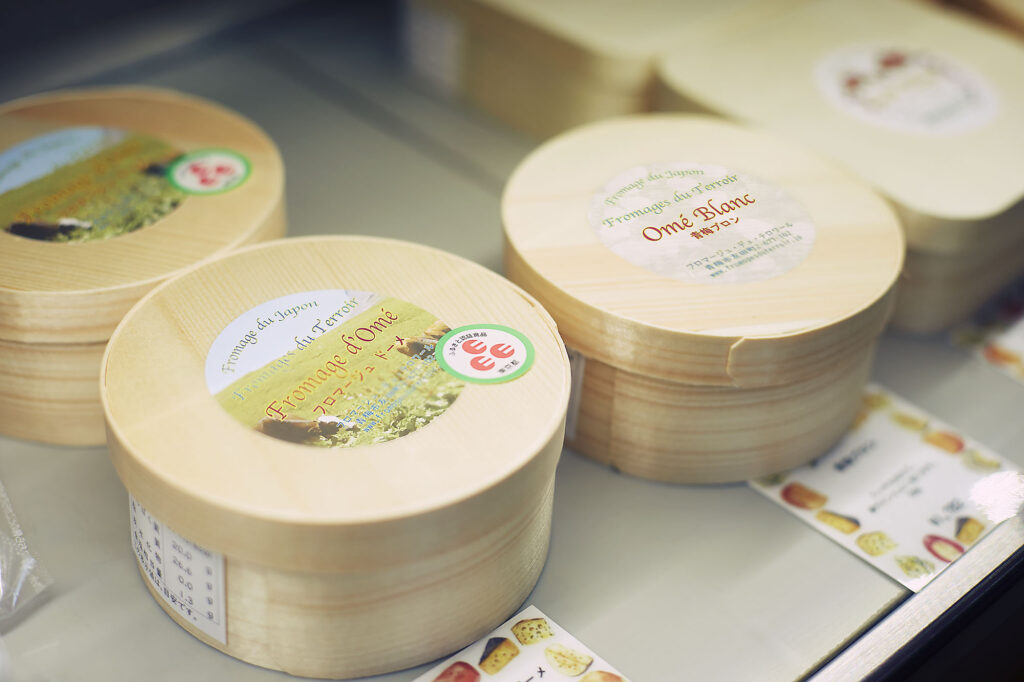
——Tell us about your signature cheese, Fromage d’Omé.
KT: I created this cheese with Époisses in mind—the classic washed-rind from France—but kept pushing to find a flavor that could belong only to Ome. As the microorganisms from the local Ozawa Sake Brewery intertwined with those in our workshop, the cheese developed a layered, resonant depth, with aromas reminiscent of miso and sake lees.
Époisses itself once vanished from production before being revived, and today several producers, including major ones, make it again. I read through French texts to study its methods and decided to develop a version using local sake from Ome. At first, I washed the rind with shochu, but when I tasted an aged sake produced by the brewery it was so delicious that I wondered, “What if I tried using this?” The challenge, however, was that aged sake varies from year to year, comes in limited quantities, and its price isn’t stable. Just when I was struggling with how to continue, I was introduced to Genroku. It has a flavor profile close to aged sake, and it is brewed with Ozawa Sake Brewery’s own native lactic bacteria and yeast. In other words, it is a sake made almost entirely through local microorganisms.
Traditional sake brewing in Japan once reflected the microbes and environment unique to each brewery, but today many use purchased yeast, giving the impression that the industry is gradually shifting toward a more industrial, standardized style.

How Tokyo’s Artisanal Cheese Expresses Japanese Terroir Through Milk, Microbes, and Craft
——What challenges did you face in bringing your ideal cheese to life?
KT: It took three full years of trial and error before I finally arrived at the cheese I had envisioned. At first, I used a dry-aging room, which caused the rind to harden while only the inside became runny. When I switched to a high-humidity, temperature-controlled room, the opposite happened—the cheese became too soft. Many factors overlapped, and it took a long time for the process to stabilize. The moisture level at the moment of unmolding, the condition of our own lactic cultures—these change every time. Even now, the cheese responds differently to each day’s temperature and humidity. It truly is work spent in conversation with a living organism.
There was once a workshop in Hokkaido that collaborated with a sake brewery to create a Japanese sake cheese, but their focus was on using sake yeast. The problem is that sake yeast has an extremely strong proteolytic effect—it breaks down proteins too aggressively—so the cheese wouldn’t mature in a stable way. I faced the same issue at first. Making fresh cheese is relatively simple, but once you try to age it, the difficulties truly begin.
——Earlier, you mentioned traditional methods. In Japan, changes in dietary habits and the environment are creating challenges for preserving washoku and other regional traditional cuisines.
KT: I’m not a big fan of very salty foods, yet when it comes to traditional umeboshi, I do think the stronger saltiness is what makes it truly delicious. My ideal is that firm, assertive flavor—the kind you can place on a bowl of rice and enjoy throughout the year. Many store-bought umeboshi today contain preservatives or honey, and those are enjoyable in their own right as “new foods.” But as those flavors become more common, I sometimes feel that the sense of what umeboshi is meant to taste like is fading.
Taste differs from person to person, of course, and perhaps more people now prefer simpler, cleaner flavors over complex ones. Still, I believe that traditions should be passed on properly. The reason I make cheese using French methods is because I want to honor that tradition while creating something unmistakably Japanese.
The same is true of lactic cultures. Even if the milk is local, introducing commercially purchased cultures can mute the expression of place. In Japan, more producers are turning to domestic cultures, but many are derived from pickles or sake lees, which behave differently from cultures developed specifically for cheese. For me, the goal is not perfect consistency. I enjoy adjusting the conditions little by little each time, exploring how the cheese’s flavor can develop and improve.
Fermentation as Culture: Where Cheese Meets Japanese Tradition
——Your blog “Cheese A to Z” often features pairings with Japanese sake.
KT: Wine and cheese are a well-known pair, but sake brings out a different harmony—one that highlights the character of both. Sake has its own lactic acidity and umami, elements it shares with cheese. The lactic notes in natural cheese, in particular, blend beautifully with sake’s gentle acidity and fermented aromas. Quite a few customers even tell me, “This goes better with sake than with wine.”
There are cheeses made with sake lees or shochu as well. When cheese is aged with sake lees, it develops a soft acidity and deep umami that meld together surprisingly well. Cheese washed with shochu gains a toasty, aromatic quality that leaves a vivid impression from the very first bite. Pairing Japan’s fermentation traditions with cheese allows us to express flavors truly rooted in place. If people can taste the climate and culture of this region through our cheeses—if they can quite literally “taste the land”—that would make me very happy.
——So Japanese fermented foods and cheese both embody the stories of their land.
KT: French cheese, in my view, plays a role very similar to tsukemono in Japan. In a French meal, dishes come out one by one, and cheese arrives at the end—something you enjoy with the remaining wine or bread to gently close the meal. In Japan, pickles play that same part with the final bites of rice. France has “a cheese for every village,” and Japan has countless regional pickles. That’s why I approach cheesemaking with the mindset of crafting tsukemono—cheese that carries the character of its land.
I love it when people from outside Japan enjoy my cheeses alongside Japanese food. Fresh mozzarella with wasabi soy sauce and a drizzle of olive oil brings out a flavor unique to Tokyo. And when paired with seasonal ingredients—mountain vegetables in spring, tomatoes in summer, mushrooms in autumn, daikon (Japanese white radish) in winter—the cheese naturally finds its place within Japanese cuisine.
——With no formal cheese schools in Japan, you’ve created your own courses to pass on the craft and support the next generation of cheesemakers. You’ve also mentioned hopes of opening a dedicated cheese school in the future.
KT: I run classes that translate what I learned in France into a structured, Japanese-language curriculum. In Japan, one of the biggest obstacles for aspiring cheesemakers is the lack of places where they can learn the fundamentals in a systematic way, from the ground up.
I came to understand this through my own experience. Because most cheesemakers in Japan are men, handling every part of the process alone—as a woman—was especially demanding. This includes duties such as sourcing raw milk, running the creamery, and managing sales. From establishing the workshop to daily production, I did everything myself, and there were moments of real isolation. But by continuing to make cheese with my own hands, day after day, I slowly earned trust.
That experience is what led me to teach. By creating a place to learn cheesemaking shaped by Japan’s climate, ingredients, and environment, I hope to give the next generation more freedom to explore what’s possible.
Note 1: Washed-rind cheeses are aged by repeatedly washed with brine or locally produced alcohol. Their interiors remain soft and mellow, while the rinds develop a pronounced aroma.
Note 2: Époisses is a powerfully aromatic cheese from Burgundy, France. It is washed with Marc—an eau-de-vie distilled from wine pomace—and brine, giving it its signature orange rind and molten, spoonable interior.
Note 3: Ozawa Sake Brewery is a historic Japanese sake brewery in Ome, founded in 1702 and known for its Sawanoi label. Genroku, a kimoto-style sake that was said to recreate the flavor of the brewery’s earliest era, is now discontinued. Kimoto is the most traditional method of sake production, in which the natural lactic bacteria and yeast present in the brewery are used to build the fermentation starter.
Kazuko Tsurumi, Founder and cheesemaker, Fromages du Terroir
Kazuko is a graduate of France’s National Dairy Industry School (ENIL) and holds certification to manage a cheese factory in France. After returning to Japan, she founded Fromages du Terroir in Ome in 2014. Working with traditional French techniques and using only Tokyo-produced milk and native lactic cultures, she creates around twenty cheeses that express a distinctly Tokyo terroir. In 2017, her cheeses became the only ones to receive the Tokyo Local Specialty Certification. She is set to open a second location in Yanaka, Tokyo, in November 2025.
About Ome
Once home to nearly 800 weavers and dyers, Ome flourished in its rich natural surroundings, cultivating a deep tradition of craftsmanship, sake brewing, and the arts. Much like indigo fabric that deepens with each layer of dye, the town’s cultural heritage has grown ever richer over time. At the heart of this legacy stands Yoshino Baigo, a massive treasured plum blossom grove where each spring, thousands of trees blanket the hillsides in delicate shades of pink and white. This grove was lovingly restored by the local community to symbolize enduring beauty and to renew and revive a spirit that lives on.
こちらの記事は英語で執筆されており、ブラウザの自動翻訳により氏名の漢字表記が正しく表示されないこと、不自然な日本語が表示されることがあるようです。お手数ですが、英語原文での閲覧をお試しください。